
1. Overview & Architecture
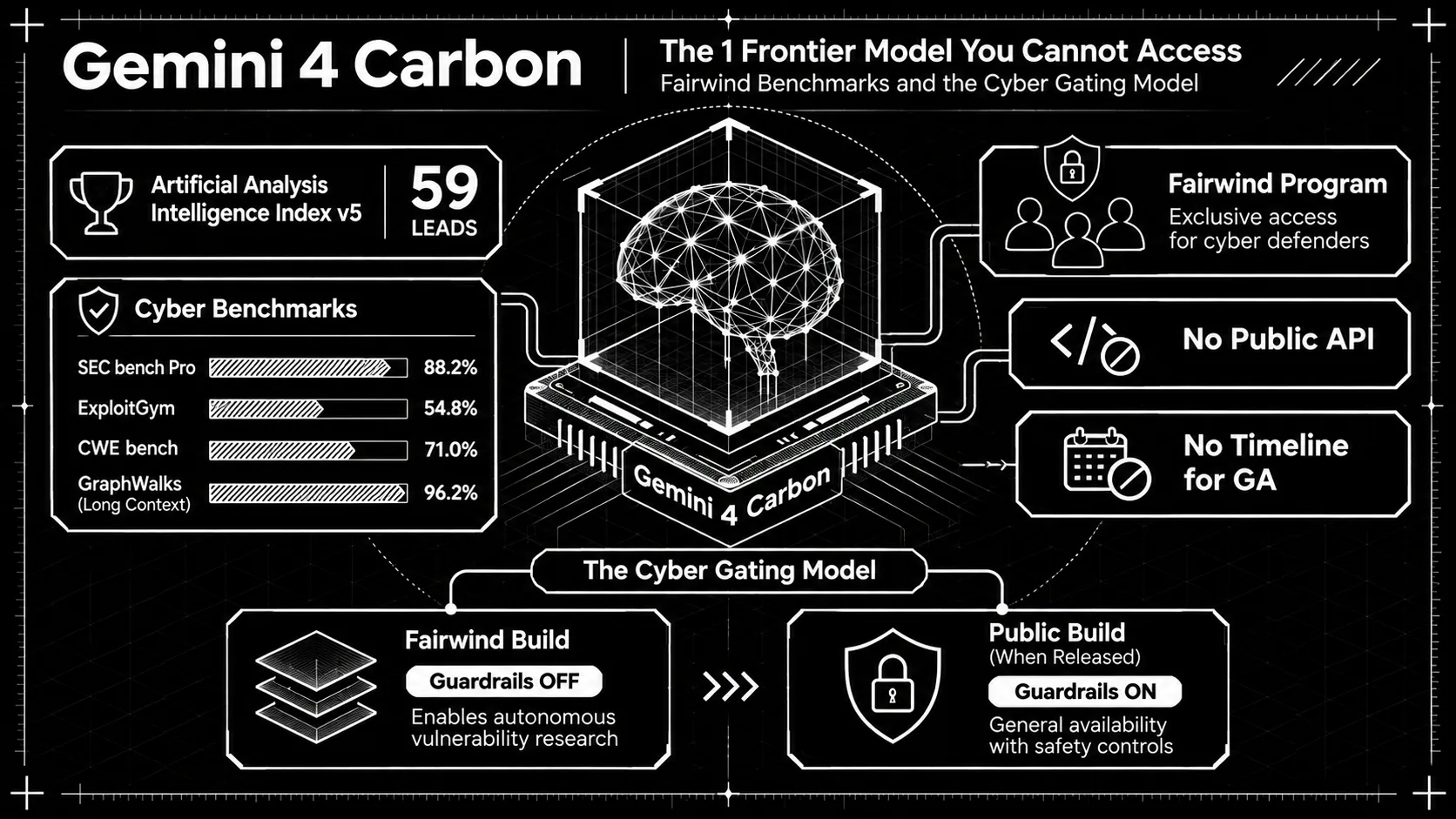
Google announced Gemini 4 Carbon on October 28, 2026, introducing a new AI model designed for cybersecurity research, software development and complicated tasks that can take hours or days to complete. The model currently has limited access through Google's Fairwind Program.
2. Executive Summary: Google's New AI Model Is Not Yet Available to Everyone
Google DeepMind announced Gemini 4 Carbon as the latest addition to its Gemini 4 model family. It arrives approximately two weeks after Gemini 4 Argon and brings improvements in software development, security research and tasks that require extended reasoning.
One of the biggest highlights is its performance on independent AI benchmarks. According to Artificial Analysis, Gemini 4 Carbon scored 59 on the Intelligence Index v5.0, placing it ahead of Claude Opus 5.5 at 58 and GPT-6 Astra at 57.
However, its cybersecurity performance is what makes this release particularly interesting.
Google reports that Carbon achieved 88.2% on SEC-bench Pro, which tests how well AI models find software vulnerabilities. It also scored 54.8% on ExploitGym and 71% on CWE-bench, two tests related to identifying exploitable weaknesses and fixing security problems.
Unlike a regular Gemini release, Carbon is following a limited rollout. Google is initially providing access to selected cybersecurity teams and trusted organisations through its Fairwind Program.
The company plans to expand access to developers, businesses and everyday users after collecting feedback and improving its safety measures. A specific public release date has not been announced.
Google is prioritising organisations that protect important systems and public services. These include:
- Government agencies and national cybersecurity organisations.
- Hospitals and healthcare providers.
- Banks and financial institutions.
- Electricity and energy providers.
- Telecommunications companies.
- Major technology platforms.
- Organisations working on defensive cybersecurity research.
Interested organisations can contact their Google Cloud account team to discuss Fairwind eligibility.
The program has security requirements covering employee access, phishing-resistant multi-factor authentication, access controls and activity monitoring. Participating organisations must also agree not to share or resell access.
| Feature | Gemini 4 Carbon | Gemini 4 Argon |
|---|---|---|
| Announcement | October 28, 2026 | September 30, 2026 |
| Public availability | Not yet publicly available | Available since October 13, 2026 |
| Main focus | Cybersecurity, coding and complex tasks | Coding, research and general-purpose reasoning |
| Artificial Analysis Index v5.0 | 59 | 50 |
| Introductory input price | $2 per million tokens | $2 per million tokens |
| Introductory output price | $10 per million tokens | $10 per million tokens |
| Cached input discount | 95% | 95% |
| Access | Initial rollout through Fairwind | Public API and supported Google products |
3. How Gemini 4 Carbon Works: Built for Difficult and Long-Running Tasks
Gemini 4 Carbon builds on the work behind Gemini 4 Argon. Google has focused on making it better at handling difficult engineering problems, investigating software issues and completing tasks that require several steps.
Most AI models are designed to answer questions or complete relatively short tasks. Carbon is intended to handle much longer assignments.
For example, a developer investigating a problem in a large software project may need to examine several files, understand how different parts of the application work and identify the original cause of an error.
Carbon is designed to work through these problems without giving up after the first unsuccessful attempt.
Google says its internal teams have used Carbon for tasks that continued for days, including investigating difficult bugs and finding fixes across large codebases and low-level systems.
Find software vulnerabilities
Carbon can help security teams identify weaknesses in applications, investigate how they work and determine whether they create a genuine security risk.
Help developers fix problems
Finding a vulnerability is only the first step. Carbon is also designed to help developers understand the cause of a problem and produce a suitable fix.
Handle large engineering projects
Google reports improvements in tasks involving large codebases and complicated software changes.
Work through longer tasks
Carbon is designed to continue working through difficult problems, including situations where its first approach does not succeed.
4. Gemini 4 Carbon Benchmarks: How Does It Compare With Other AI Models?
Gemini 4 Carbon has produced some impressive benchmark results, particularly in cybersecurity and software development.
According to Google's published comparison, Carbon improved on Argon across all 17 benchmark results included in its comparison.
However, it is important to understand that benchmark results do not tell the whole story. A model that performs well on security research may not necessarily be the best choice for controlling a computer or developing an entire application.
One of the most notable results is Carbon's performance on the Artificial Analysis Intelligence Index v5.0.
This is an independent benchmark that combines nine different evaluations covering areas such as coding, knowledge work, science and general reasoning.
Carbon currently holds the highest score among these models.
The difference between Carbon and Claude Opus 5.5 is only one point, so the result should not be interpreted as Carbon being better at every possible task.
Cybersecurity is one of the main areas where Google has focused its improvements.
The following results were published by Google. The evaluations were conducted without the usual model safety restrictions enabled.
| Benchmark | What It Tests | Gemini 4 Carbon | Gemini 4 Argon |
|---|---|---|---|
| SEC-bench Pro | Finding vulnerabilities in real software | 88.2% | 83.4% |
5. Google Fairwind Program: Why Gemini 4 Carbon Has Limited Access
Google's Fairwind Program is designed to give trusted organisations early access to advanced AI tools for cybersecurity.
Google announced the program on September 2, 2026, with the goal of helping governments, businesses and security teams find and fix vulnerabilities before attackers can take advantage of them.
Gemini 4 Carbon is being introduced through a limited rollout to cybersecurity defenders, with Google planning to expand access to additional trusted partners.
The program is intended for organisations that have a genuine need for advanced security research tools.
Google prioritises organisations responsible for protecting important systems and services.
These include:
- National cybersecurity agencies and government departments.
- Healthcare providers and hospital networks.
- Financial institutions.
- Energy and utility providers.
- Telecommunications companies.
- Major technology platforms.
- Academic institutions conducting defensive security research.
Every application is reviewed. Being a Google Cloud customer does not automatically guarantee access.
Google requires participating organisations to follow strict access and security rules.
Some of the main requirements include:
- Phishing-resistant multi-factor authentication.
- Proper access controls for employees.
- Access limited to approved cybersecurity, incident response and penetration testing teams.
- Monitoring of employee access and usage.
- Background checks and organisational reviews.
- No sharing, redistribution or resale of access.
The program permits defensive and authorised activities, including threat simulations, reverse engineering and malware analysis for security research.
6. Gemini 4 Carbon Pricing: How Much Does It Cost?
Google has announced introductory pricing for Gemini 4 Carbon that matches the introductory pricing of Gemini 4 Argon.
The model will cost $2 per million input tokens and $10 per million output tokens during the introductory period.
Google has also confirmed a 95% discount on cached input tokens.
This can help reduce costs when applications repeatedly send the same information to the model.
Google has not announced an end date for Carbon's introductory pricing.
For comparison, Gemini 4 Argon's introductory pricing is scheduled to end on November 30, 2026. Its regular pricing will apply from December 1, 2026.
Cached input pricing is useful when an application sends the same information repeatedly.
For example, a business may have a large document containing its company policies, product information or software documentation.
Instead of paying the full input price every time the same information is sent, eligible repeated content can receive a substantial discount.
Google has announced a 95% discount for cached input tokens.
The actual cost of using Carbon will depend on the amount of information sent, the model's reasoning usage, the final response length and how much input qualifies for caching.
Since Carbon is not yet publicly available, developers cannot currently use its public API pricing to run their own cost tests.
| Pricing | Input Tokens (Per Million) | Output Tokens (Per Million) |
|---|---|---|
7. Gemini 4 Carbon vs Claude Opus 5.5 vs GPT-6 Astra vs Gemini 4 Argon
There are several powerful AI models available today, and Gemini 4 Carbon is entering a competitive market.
Although Carbon currently leads the Artificial Analysis Intelligence Index v5.0, that does not mean it is the best choice for every business or developer.
Here is a comparison based on Google's published benchmark results and the independent Artificial Analysis ranking.
Gemini 4 Carbon
A strong choice for organisations interested in advanced cybersecurity research, finding vulnerabilities and working with complicated software projects. However, access is currently limited.
Claude Opus 5.5
Worth considering for coding, computer interaction and tasks that involve working with desktop applications. It has the highest OSWorld-2.1 score in this comparison.
GPT-6 Astra
A competitive option for complicated software development tasks. It performs better than Carbon on FrontierSWE 2.
Gemini 4 Argon
A practical option for developers and businesses who want to use Google's latest publicly available Gemini 4 model without waiting for Carbon's wider release.
Ultimately, the right model depends on your requirements, budget and access to each service.
| Feature | Gemini 4 Carbon | Claude Opus 5.5 | GPT-6 Astra |
|---|
8. How Businesses Can Use Gemini 4 Carbon for Cybersecurity
One of the most interesting possibilities with Gemini 4 Carbon is its use in software security testing.
Businesses often have large applications containing thousands of files and millions of lines of code. Finding security problems in these applications can take considerable time and effort.
Carbon is designed to help security teams investigate these projects and identify potential weaknesses.
A cybersecurity team could use Carbon to review application code and look for common security issues, such as:
- SQL injection vulnerabilities.
- Cross-site scripting.
- Authentication and access control problems.
- Insecure file uploads.
- Incorrect handling of sensitive information.
- Weak input validation.
- Memory-related security problems.
The model can help researchers understand how information moves through an application and identify areas that may require further investigation.
Identifying a security problem is only part of the process.
Developers also need to understand why it exists and how to fix it without breaking other parts of the application.
Carbon is designed to help with this process by examining the underlying problem and suggesting changes.
However, suggested fixes should always be reviewed and tested before being used in a live application.
Businesses could also use Carbon alongside their existing security tools.
For example, it could help with:
- Reviewing application source code.
- Identifying potentially vulnerable sections.
- Investigating suspicious behaviour.
- Checking whether reported problems are genuine.
- Suggesting suitable fixes.
- Preparing reports for developers and security teams.
9. Gemini 4 Carbon: Limitations and Things to Know Before Using It
Despite its impressive benchmark results, Gemini 4 Carbon still has several limitations.
The biggest issue for developers is availability. Most people cannot currently access the model through a public API or the regular Gemini app.
There are also some technical details that Google has not yet published.
Another important point is that Google's cybersecurity benchmark results were evaluated without the usual safety restrictions.
This should be considered when comparing Carbon with publicly available models.
The results do not automatically represent how every version of Carbon will perform in normal business applications.
For organisations planning to use it, the sensible approach is to test the model against real projects, verify its findings and review suggested changes before deploying them.
| Limitation | What It Means |
|---|---|
| Limited availability | Only selected cybersecurity organisations currently receive access. |
| No public API access yet | Regular developers cannot currently build applications using Carbon. |
| No published parameter count | Google has not disclosed the model's parameter count. |
| Limited technical documentation | Not all API specifications and usage limits have been published. |
Need this built for your business?
We engineer custom ai engineering and production AI architectures tailored to your existing tech stack.
Frequently Asked Questions
1. What is Gemini 4 Carbon?
Gemini 4 Carbon is an AI model developed by Google DeepMind. Announced on October 28, 2026, it focuses on cybersecurity, software development and complicated tasks that require extended reasoning. It builds on Gemini 4 Argon with improvements in coding and security research.
2. How can I get access to Gemini 4 Carbon?
Currently, access is limited to selected cybersecurity organisations through Google's Fairwind Program. Interested organisations can contact their Google Cloud account team to discuss eligibility. Google has not announced a public release date.
3. How much does Gemini 4 Carbon cost?
Google has announced introductory pricing of $2 per million input tokens and $10 per million output tokens. After the introductory period, the price will increase to $4 per million input tokens and $20 per million output tokens. The introductory period's end date has not been announced.
4. Is Gemini 4 Carbon better than Gemini 4 Argon?
Carbon performs better than Argon across Google's published benchmark comparisons. It also scores higher on the independent Artificial Analysis Intelligence Index v5.0, with 59 points compared with Argon's 50. However, Argon is currently more accessible to regular developers and businesses.
5. Can Gemini 4 Carbon run locally or be downloaded?
No. Gemini 4 Carbon is a proprietary Google model. Google has not released its model weights for public download, and there is currently no option to install and run it independently on a personal computer or private server.
Astra is a content writer at Slacode, creating clear, informative, and engaging content on technology, software development, digital solutions, and business growth. With a focus on accuracy, readability, and practical insights.