
/
Architecture Cyber Benchmarks and the Identity Gated Release Strategy That Redefines Frontier Deployment
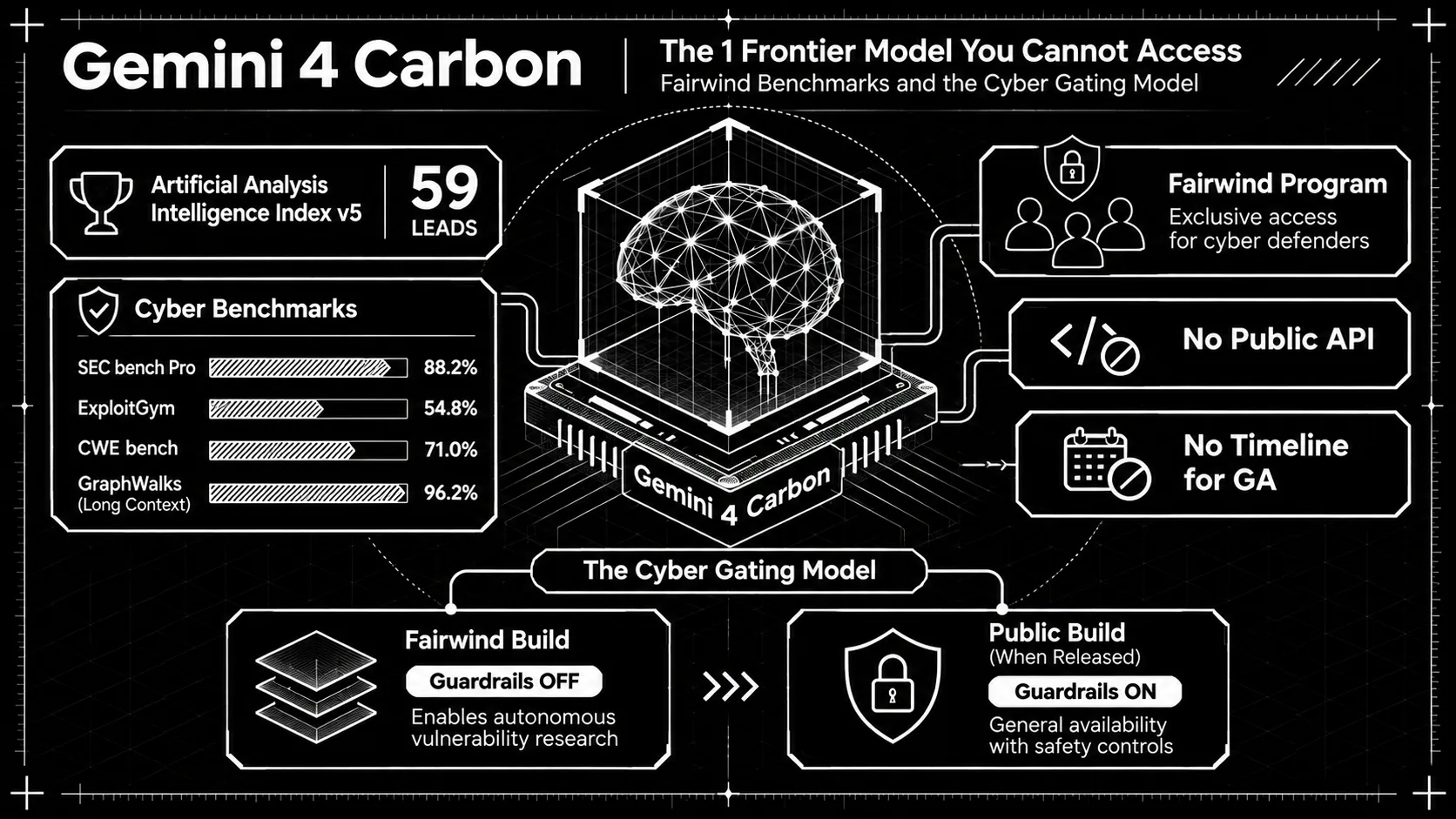
Gemini 4 Carbon tops the Artificial Analysis Intelligence Index v5 at 59 leads on cyber benchmarks SEC bench Pro 88.2% ExploitGym 54.8% CWE bench 71.0% and long context reasoning GraphWalks 96.2% but ships exclusively to Fairwind Program cyber defenders No public API no timeline for GA The Fairwind guardrails off build enables autonomous vulnerability research public build when released will have guardrails ON
Google announced Gemini 4 Carbon on October 28, 2026, introducing a new AI model designed for cybersecurity research, software development and complicated tasks that can take hours or days to complete. The model currently has limited access through Google's Fairwind Program.
Google DeepMind announced Gemini 4 Carbon as the latest addition to its Gemini 4 model family. It arrives approximately two weeks after Gemini 4 Argon and brings improvements in software development, security research and tasks that require extended reasoning.
One of the biggest highlights is its performance on independent AI benchmarks. According to Artificial Analysis, Gemini 4 Carbon scored 59 on the Intelligence Index v5.0, placing it ahead of Claude Opus 5.5 at 58 and GPT-6 Astra at 57.
However, its cybersecurity performance is what makes this release particularly interesting.
Google reports that Carbon achieved 88.2% on SEC-bench Pro, which tests how well AI models find software vulnerabilities. It also scored 54.8% on ExploitGym and 71% on CWE-bench, two tests related to identifying exploitable weaknesses and fixing security problems.
Unlike a regular Gemini release, Carbon is following a limited rollout. Google is initially providing access to selected cybersecurity teams and trusted organisations through its Fairwind Program.
The company plans to expand access to developers, businesses and everyday users after collecting feedback and improving its safety measures. A specific public release date has not been announced.
Google is prioritising organisations that protect important systems and public services. These include:
Interested organisations can contact their Google Cloud account team to discuss Fairwind eligibility.
The program has security requirements covering employee access, phishing-resistant multi-factor authentication, access controls and activity monitoring. Participating organisations must also agree not to share or resell access.
| Feature | Gemini 4 Carbon | Gemini 4 Argon |
|---|---|---|
| Announcement | October 28, 2026 | September 30, 2026 |
| Public availability | Not yet publicly available | Available since October 13, 2026 |
| Main focus | Cybersecurity, coding and complex tasks | Coding, research and general-purpose reasoning |
| Artificial Analysis Index v5.0 | 59 | 50 |
| Introductory input price | $2 per million tokens | $2 per million tokens |
| Introductory output price | $10 per million tokens | $10 per million tokens |
| Cached input discount | 95% | 95% |
| Access | Initial rollout through Fairwind | Public API and supported Google products |
Gemini 4 Carbon builds on the work behind Gemini 4 Argon. Google has focused on making it better at handling difficult engineering problems, investigating software issues and completing tasks that require several steps.
Most AI models are designed to answer questions or complete relatively short tasks. Carbon is intended to handle much longer assignments.
For example, a developer investigating a problem in a large software project may need to examine several files, understand how different parts of the application work and identify the original cause of an error.
Carbon is designed to work through these problems without giving up after the first unsuccessful attempt.
Google says its internal teams have used Carbon for tasks that continued for days, including investigating difficult bugs and finding fixes across large codebases and low-level systems.
Find software vulnerabilities
Carbon can help security teams identify weaknesses in applications, investigate how they work and determine whether they create a genuine security risk.
Help developers fix problems
Finding a vulnerability is only the first step. Carbon is also designed to help developers understand the cause of a problem and produce a suitable fix.
Handle large engineering projects
Google reports improvements in tasks involving large codebases and complicated software changes.
Work through longer tasks
Carbon is designed to continue working through difficult problems, including situations where its first approach does not succeed.
Improve coding quality
Google reports that Carbon more than doubled Argon's success rate on certain internal secure coding tests.
Google has not published a complete technical specification for Carbon, including its parameter count or a detailed description of its architecture.
However, its announcement confirms that the model builds on Gemini 4 Argon and includes improvements to coding, scientific tasks, software development and multimodal understanding.
Argon supports a unified context window of approximately one million tokens. Google has not published a separate technical specification confirming that every Argon limit and feature carries over unchanged to Carbon.
For that reason, developers should avoid assuming that both models have identical API limits or technical capabilities.
Gemini 4 Carbon has produced some impressive benchmark results, particularly in cybersecurity and software development.
According to Google's published comparison, Carbon improved on Argon across all 17 benchmark results included in its comparison.
However, it is important to understand that benchmark results do not tell the whole story. A model that performs well on security research may not necessarily be the best choice for controlling a computer or developing an entire application.
One of the most notable results is Carbon's performance on the Artificial Analysis Intelligence Index v5.0.
This is an independent benchmark that combines nine different evaluations covering areas such as coding, knowledge work, science and general reasoning.
Carbon currently holds the highest score among these models.
The difference between Carbon and Claude Opus 5.5 is only one point, so the result should not be interpreted as Carbon being better at every possible task.
Cybersecurity is one of the main areas where Google has focused its improvements.
The following results were published by Google. The evaluations were conducted without the usual model safety restrictions enabled.
| Benchmark | What It Tests | Gemini 4 Carbon | Gemini 4 Argon |
|---|---|---|---|
| SEC-bench Pro | Finding vulnerabilities in real software | 88.2% | 83.4% |
| ExploitGym | Checking whether vulnerabilities can be exploited | 54.8% | 42.0% |
| CWE-bench | Finding and fixing the underlying cause of security problems | 71.0% | 68.0% |
These results suggest that Carbon is better at identifying vulnerabilities and helping developers fix them than its predecessor.
However, the results come from controlled testing. They do not guarantee that Carbon will find every vulnerability in a real-world application.
Google also tested Carbon against other leading models on software development tasks.
| Benchmark | What It Tests | Carbon | Argon | GPT-6 Astra | Claude Opus 5.5 |
|---|---|---|---|---|---|
| FrontierSWE 2 | Complex changes across multiple files | 61.2% | 55.0% | 65.5% | 62.3% |
| Terminal-Bench 4.0 | Working with command-line tools | 65.2% | 57.1% | 59.1% | 59.6% |
| SWE-sweep | Completing software development tasks | 9.6% | 4.3% | 9.5% | 3.6% |
| Vals Index v2.2 | Finance, coding, legal and tax tasks | 70.4% | 69.2% | 65.0% | 70.2% |
Carbon performs particularly well on Terminal-Bench 4.0, which tests how effectively models work with command-line tools and complete technical tasks.
However, GPT-6 Astra still performs better on FrontierSWE 2, which focuses on complicated changes across multiple files.
Another interesting area is how well Carbon handles large amounts of information and tasks involving computer interaction.
| Benchmark | What It Tests | Carbon | Argon | GPT-6 Astra | Claude Opus 5.5 |
|---|---|---|---|---|---|
| GraphWalks 256K–1M | Understanding relationships across large amounts of information | 96.2% | 84.2% | 71.8% | 66.8% |
| Agents' Last Exam v1.1 | Completing long-running tasks | 77.4% | 69.0% | 73.1% | 71.6% |
| OSWorld-2.1 | Interacting with computer environments | 81.5% | 74.7% | 80.9% | 87.2% |
Carbon's GraphWalks result is particularly impressive. It scored 96.2%, compared with Argon's 84.2%.
However, Claude Opus 5.5 performs better on OSWorld-2.1, which tests computer interaction.
This shows why choosing an AI model based on a single overall ranking can be misleading. The best model depends on the work you want it to perform.
| AI Model | Intelligence Index v5.0 |
|---|---|
| Gemini 4 Carbon | 59 |
| Claude Opus 5.5 | 58 |
| GPT-6 Astra | 57 |
| Gemini 4 Argon | 50 |
Google's Fairwind Program is designed to give trusted organisations early access to advanced AI tools for cybersecurity.
Google announced the program on September 2, 2026, with the goal of helping governments, businesses and security teams find and fix vulnerabilities before attackers can take advantage of them.
Gemini 4 Carbon is being introduced through a limited rollout to cybersecurity defenders, with Google planning to expand access to additional trusted partners.
The program is intended for organisations that have a genuine need for advanced security research tools.
Google prioritises organisations responsible for protecting important systems and services.
These include:
Every application is reviewed. Being a Google Cloud customer does not automatically guarantee access.
Google requires participating organisations to follow strict access and security rules.
Some of the main requirements include:
The program permits defensive and authorised activities, including threat simulations, reverse engineering and malware analysis for security research.
Malicious activities, such as creating malware, are not permitted.
Organisations interested in joining the Fairwind Program should contact their Google Cloud account team.
Google reviews applications and contacts eligible organisations. There is no guarantee of acceptance, and the company has not published a fixed application processing time.
Organisations that do not qualify can still explore Google's publicly available security products, including CodeMender and its other AI security tools.
Google has announced introductory pricing for Gemini 4 Carbon that matches the introductory pricing of Gemini 4 Argon.
The model will cost $2 per million input tokens and $10 per million output tokens during the introductory period.
Google has also confirmed a 95% discount on cached input tokens.
This can help reduce costs when applications repeatedly send the same information to the model.
Google has not announced an end date for Carbon's introductory pricing.
For comparison, Gemini 4 Argon's introductory pricing is scheduled to end on November 30, 2026. Its regular pricing will apply from December 1, 2026.
Cached input pricing is useful when an application sends the same information repeatedly.
For example, a business may have a large document containing its company policies, product information or software documentation.
Instead of paying the full input price every time the same information is sent, eligible repeated content can receive a substantial discount.
Google has announced a 95% discount for cached input tokens.
The actual cost of using Carbon will depend on the amount of information sent, the model's reasoning usage, the final response length and how much input qualifies for caching.
Since Carbon is not yet publicly available, developers cannot currently use its public API pricing to run their own cost tests.
| Pricing | Input Tokens (Per Million) | Output Tokens (Per Million) |
|---|---|---|
| Introductory price | $2.00 | $10.00 |
| Regular price | $4.00 | $20.00 |
| Cached input discount | 95% off input pricing | Not applicable |
There are several powerful AI models available today, and Gemini 4 Carbon is entering a competitive market.
Although Carbon currently leads the Artificial Analysis Intelligence Index v5.0, that does not mean it is the best choice for every business or developer.
Here is a comparison based on Google's published benchmark results and the independent Artificial Analysis ranking.
Gemini 4 Carbon
A strong choice for organisations interested in advanced cybersecurity research, finding vulnerabilities and working with complicated software projects. However, access is currently limited.
Claude Opus 5.5
Worth considering for coding, computer interaction and tasks that involve working with desktop applications. It has the highest OSWorld-2.1 score in this comparison.
GPT-6 Astra
A competitive option for complicated software development tasks. It performs better than Carbon on FrontierSWE 2.
Gemini 4 Argon
A practical option for developers and businesses who want to use Google's latest publicly available Gemini 4 model without waiting for Carbon's wider release.
Ultimately, the right model depends on your requirements, budget and access to each service.
| Feature | Gemini 4 Carbon | Claude Opus 5.5 | GPT-6 Astra | Gemini 4 Argon |
|---|---|---|---|---|
| Release | October 28, 2026 | September 22, 2026 | September 28, 2026 | October 13, 2026 |
| Public access | Limited rollout | Available | Available | Available |
| Intelligence Index v5.0 | 59 | 58 | 57 | 50 |
| GraphWalks 256K–1M | 96.2% | 66.8% | 71.8% | 84.2% |
| FrontierSWE 2 | 61.2% | 62.3% | 65.5% | 55.0% |
| Terminal-Bench 4.0 | 65.2% | 59.6% | 59.1% | 57.1% |
| OSWorld-2.1 | 81.5% | 87.2% | 80.9% | 74.7% |
| SEC-bench Pro | 88.2% | Not listed | 85.4% | 83.4% |
One of the most interesting possibilities with Gemini 4 Carbon is its use in software security testing.
Businesses often have large applications containing thousands of files and millions of lines of code. Finding security problems in these applications can take considerable time and effort.
Carbon is designed to help security teams investigate these projects and identify potential weaknesses.
A cybersecurity team could use Carbon to review application code and look for common security issues, such as:
The model can help researchers understand how information moves through an application and identify areas that may require further investigation.
Identifying a security problem is only part of the process.
Developers also need to understand why it exists and how to fix it without breaking other parts of the application.
Carbon is designed to help with this process by examining the underlying problem and suggesting changes.
However, suggested fixes should always be reviewed and tested before being used in a live application.
Businesses could also use Carbon alongside their existing security tools.
For example, it could help with:
The goal is to reduce repetitive work and help security professionals spend more time investigating important problems.
AI should remain an additional tool in the security process rather than a replacement for experienced researchers and developers.
Despite its impressive benchmark results, Gemini 4 Carbon still has several limitations.
The biggest issue for developers is availability. Most people cannot currently access the model through a public API or the regular Gemini app.
There are also some technical details that Google has not yet published.
Another important point is that Google's cybersecurity benchmark results were evaluated without the usual safety restrictions.
This should be considered when comparing Carbon with publicly available models.
The results do not automatically represent how every version of Carbon will perform in normal business applications.
For organisations planning to use it, the sensible approach is to test the model against real projects, verify its findings and review suggested changes before deploying them.
| Limitation | What It Means |
|---|---|
| Limited availability | Only selected cybersecurity organisations currently receive access. |
| No public API access yet | Regular developers cannot currently build applications using Carbon. |
| No published parameter count | Google has not disclosed the model's parameter count. |
| Limited technical documentation | Not all API specifications and usage limits have been published. |
| No announced pricing end date | The duration of introductory pricing remains unknown. |
| Benchmark limitations | Strong test results do not guarantee the same performance in real-world projects. |
| Not the best in every category | Other models perform better on certain coding and computer-use tests. |
| Security restrictions | Access and permitted activities depend on Google's program requirements. |
We engineer custom ai engineering and production AI architectures tailored to your existing tech stack.
Gemini 4 Carbon is an AI model developed by Google DeepMind. Announced on October 28, 2026, it focuses on cybersecurity, software development and complicated tasks that require extended reasoning. It builds on Gemini 4 Argon with improvements in coding and security research.
Currently, access is limited to selected cybersecurity organisations through Google's Fairwind Program. Interested organisations can contact their Google Cloud account team to discuss eligibility. Google has not announced a public release date.
Google has announced introductory pricing of $2 per million input tokens and $10 per million output tokens. After the introductory period, the price will increase to $4 per million input tokens and $20 per million output tokens. The introductory period's end date has not been announced.
Carbon performs better than Argon across Google's published benchmark comparisons. It also scores higher on the independent Artificial Analysis Intelligence Index v5.0, with 59 points compared with Argon's 50. However, Argon is currently more accessible to regular developers and businesses.
No. Gemini 4 Carbon is a proprietary Google model. Google has not released its model weights for public download, and there is currently no option to install and run it independently on a personal computer or private server.
Astra is a content writer at Slacode, creating clear, informative, and engaging content on technology, software development, digital solutions, and business growth. With a focus on accuracy, readability, and practical insights.
770 Billion Parameters 49 Billion Active 1 Million Context Native Visual Understanding Computer Use CLI GUI
Scheduling Determinism Token Economics and the Security Model of the MIT Licensed Prototype