/
Linear webhooks fail when business logic gets messy. Here is how we architect stateful, self-healing agent pipelines with human-in-the-loop review gates.
Linear automations break because they lack state memory, error recovery loops, and conditional reasoning. By migrating enterprise workflows to self-hosted n8n pipelines orchestrated with LangGraph state graphs, businesses gain self-healing retry logic, human approval gates, and 100% data privacy compliance.
Most growing companies start automating operations using tools like Zapier or Make. Initially, a 3-step Zap (New Form -> Add to CRM -> Send Slack Alert) works fine.
However, as business operations scale, reality intervenes: leads enter misspelled email domains, external CRMs return HTTP 429 rate limit errors, or invoice PDFs arrive as blurry phone photos. In a linear pipeline, a single failure crashes the entire execution, dropping the lead on the floor with zero automated recovery.
Fixing this with more conditional branches creates an unmaintainable maze of 'spaghetti zaps' costing thousands of dollars a month in per-task usage tiers.
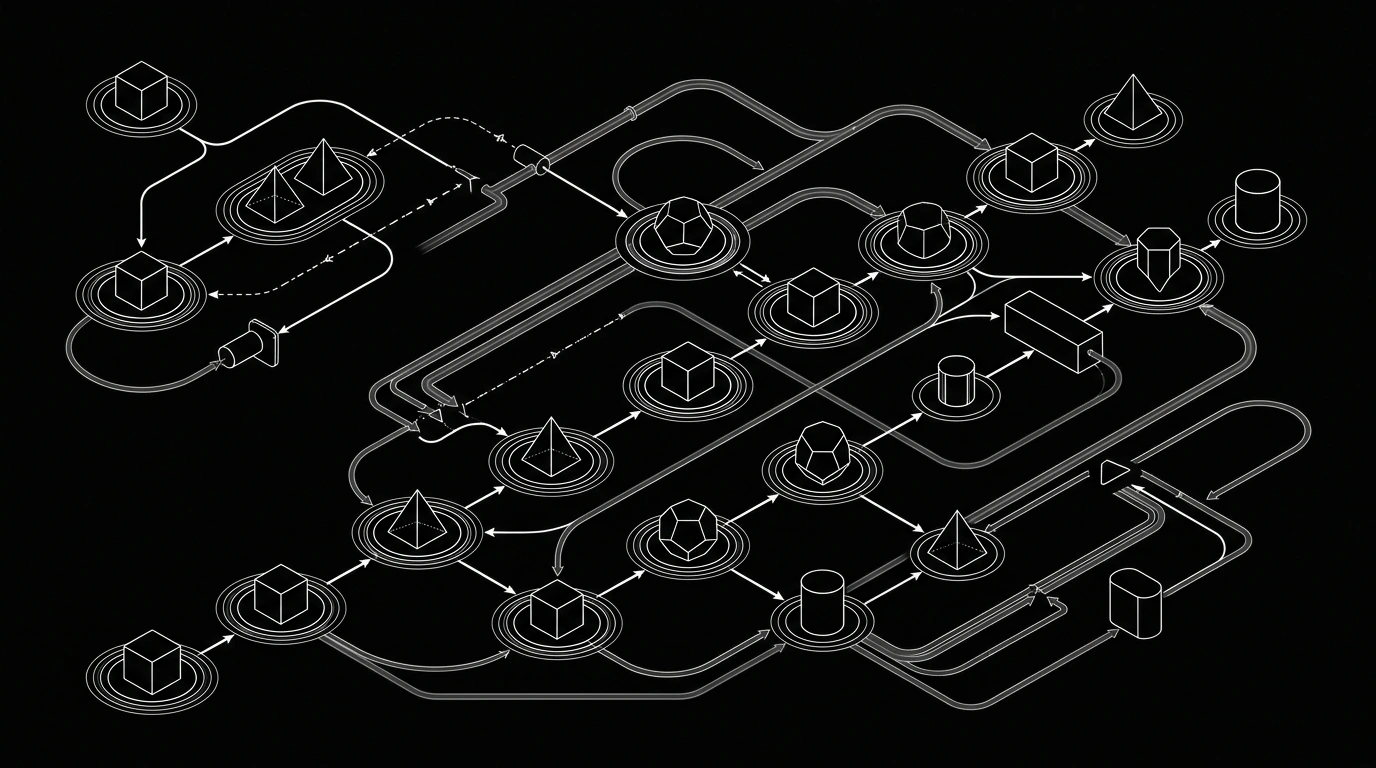
Unlike linear step-runners, LangGraph models automated workflows as a Directed Acyclic Graph (DAG) with a shared state object. Each node in the graph represents a specialized tool, AI model, or validation checkpoint:
// workflows/leadEnrichmentGraph.ts
import { StateGraph, END } from "@langchain/langgraph";

interface LeadState {
  rawEmail: string;
  companyDomain?: string;
  enrichmentRetries: number;
  qualified: boolean;
  score: number;
  requiresHumanReview: boolean;
}

const workflow = new StateGraph<LeadState>({
  channels: { /* state schema */ }
})
  .addNode("enrich_domain", async (state) => {
    const data = await queryClearbit(state.companyDomain);
    return { ...state, score: data.employeeCount > 50 ? 85 : 40 };
  })
  .addNode("human_approval_gate", async (state) => {
    await sendSlackApprovalInteractive(state);
    return { ...state, requiresHumanReview: true };
  })
  .addConditionalEdges("enrich_domain", (state) => {
    if (state.score > 80) return "human_approval_gate";
    return END;
});For enterprise clients with strict HIPAA, GDPR, or SOC 2 compliance requirements, third-party cloud automation platforms pose serious data privacy hurdles because confidential client records traverse shared multi-tenant infrastructure.
Deploying self-hosted n8n inside client AWS/GCP VPCs alongside LangGraph worker nodes guarantees zero third-party data egress. Furthermore, because self-hosted n8n is open-core, processing 500,000 automated tasks per month costs nothing in per-task licensing fees—only raw compute.
[!BENCHMARK] A business running 350,000 monthly automation tasks often pays $1,200–$2,500/month on cloud SaaS automation tools. Running the same volume on self-hosted n8n in Docker costs ~$40/month in cloud server resources.
We engineer custom autonomous ai agents & workflows and production AI architectures tailored to your existing tech stack.
Yes. LangGraph workflows integrate seamlessly with Salesforce, HubSpot, Pipedrive, and custom PostgreSQL databases via direct API connectors or n8n webhook nodes.
A HITL gate pauses an autonomous workflow when a high-stakes decision threshold is reached (e.g. sending a custom $10k proposal or modifying customer billing), sending an interactive Slack or email prompt for human team sign-off before proceeding.
Principal Engineer at Slacode focusing on real-time WebRTC voice telephony, low-latency LLM orchestration, and distributed vector retrieval engines.
770 Billion Parameters 49 Billion Active 1 Million Context Native Visual Understanding Computer Use CLI GUI
Scheduling Determinism Token Economics and the Security Model of the MIT Licensed Prototype