1. The Fragility of Linear 'If-This-Then-That' Pipelines
Most growing companies start automating operations using tools like Zapier or Make. Initially, a 3-step Zap (New Form -> Add to CRM -> Send Slack Alert) works fine.
However, as business operations scale, reality intervenes: leads enter misspelled email domains, external CRMs return HTTP 429 rate limit errors, or invoice PDFs arrive as blurry phone photos. In a linear pipeline, a single failure crashes the entire execution, dropping the lead on the floor with zero automated recovery.
Fixing this with more conditional branches creates an unmaintainable maze of 'spaghetti zaps' costing thousands of dollars a month in per-task usage tiers.
2. The Paradigm Shift: Stateful Agent Graphs
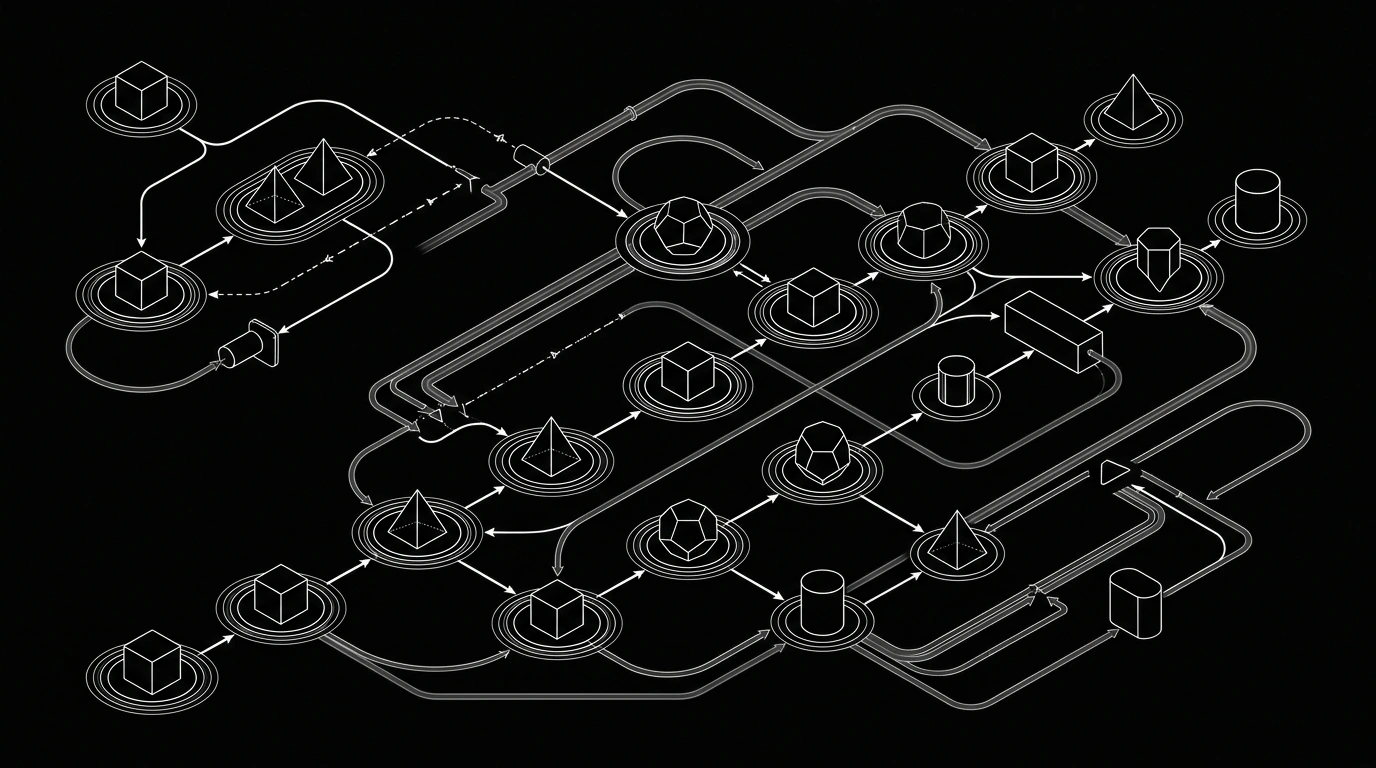
Unlike linear step-runners, LangGraph models automated workflows as a Directed Acyclic Graph (DAG) with a shared state object. Each node in the graph represents a specialized tool, AI model, or validation checkpoint:
- Inspect State: The node evaluates the current state and decides the next transition.
- Self-Healing Loops: If an API fails or an extraction validation score is low, the graph routes the task back to a correction node with contextual feedback rather than terminating.
- Checkpoint Persistence: State is written to PostgreSQL after every node. If a server reboots mid-execution, the pipeline resumes exactly from the last completed node.
// workflows/leadEnrichmentGraph.ts
import { StateGraph, END } from "@langchain/langgraph";

interface LeadState {
  rawEmail: string;
  companyDomain?: string;
  enrichmentRetries: number;
  qualified: boolean;
  score: number;
  requiresHumanReview: boolean;
}

const workflow = new StateGraph<LeadState>({
  channels: { /* state schema */ }
})
  .addNode("enrich_domain", async (state) => {
    const data = await queryClearbit(state.companyDomain);
    return { ...state, score: data.employeeCount > 50 ? 85 : 40 };
  })
  .addNode("human_approval_gate", async (state) => {
    await sendSlackApprovalInteractive(state);
    return { ...state, requiresHumanReview: true };
  })
  .addConditionalEdges("enrich_domain", (state) => {
    if (state.score > 80) return "human_approval_gate";
    return END;
  });
3. Why Self-Hosted n8n Wins on Cost & Privacy
For enterprise clients with strict HIPAA, GDPR, or SOC 2 compliance requirements, third-party cloud automation platforms pose serious data privacy hurdles because confidential client records traverse shared multi-tenant infrastructure.
Deploying self-hosted n8n inside client AWS/GCP VPCs alongside LangGraph worker nodes guarantees zero third-party data egress. Furthermore, because self-hosted n8n is open-core, processing 500,000 automated tasks per month costs nothing in per-task licensing fees—only raw compute.
[!BENCHMARK] A business running 350,000 monthly automation tasks often pays $1,200–$2,500/month on cloud SaaS automation tools. Running the same volume on self-hosted n8n in Docker costs ~$40/month in cloud server resources.
Need this built for your business?
We engineer custom autonomous ai agents & workflows and production AI architectures tailored to your existing tech stack.
Frequently Asked Questions
Can LangGraph workflows connect directly into our existing CRMs?
Yes. LangGraph workflows integrate seamlessly with Salesforce, HubSpot, Pipedrive, and custom PostgreSQL databases via direct API connectors or n8n webhook nodes.
What is a Human-In-The-Loop (HITL) gate?
A HITL gate pauses an autonomous workflow when a high-stakes decision threshold is reached (e.g. sending a custom $10k proposal or modifying customer billing), sending an interactive Slack or email prompt for human team sign-off before proceeding.
Principal Engineer at Slacode focusing on real-time WebRTC voice telephony, low-latency LLM orchestration, and distributed vector retrieval engines.