
1. Executive Summary Thinking Machines Lab Ships Inkling 2 Small a 594B MoE With 17B Active Parameters
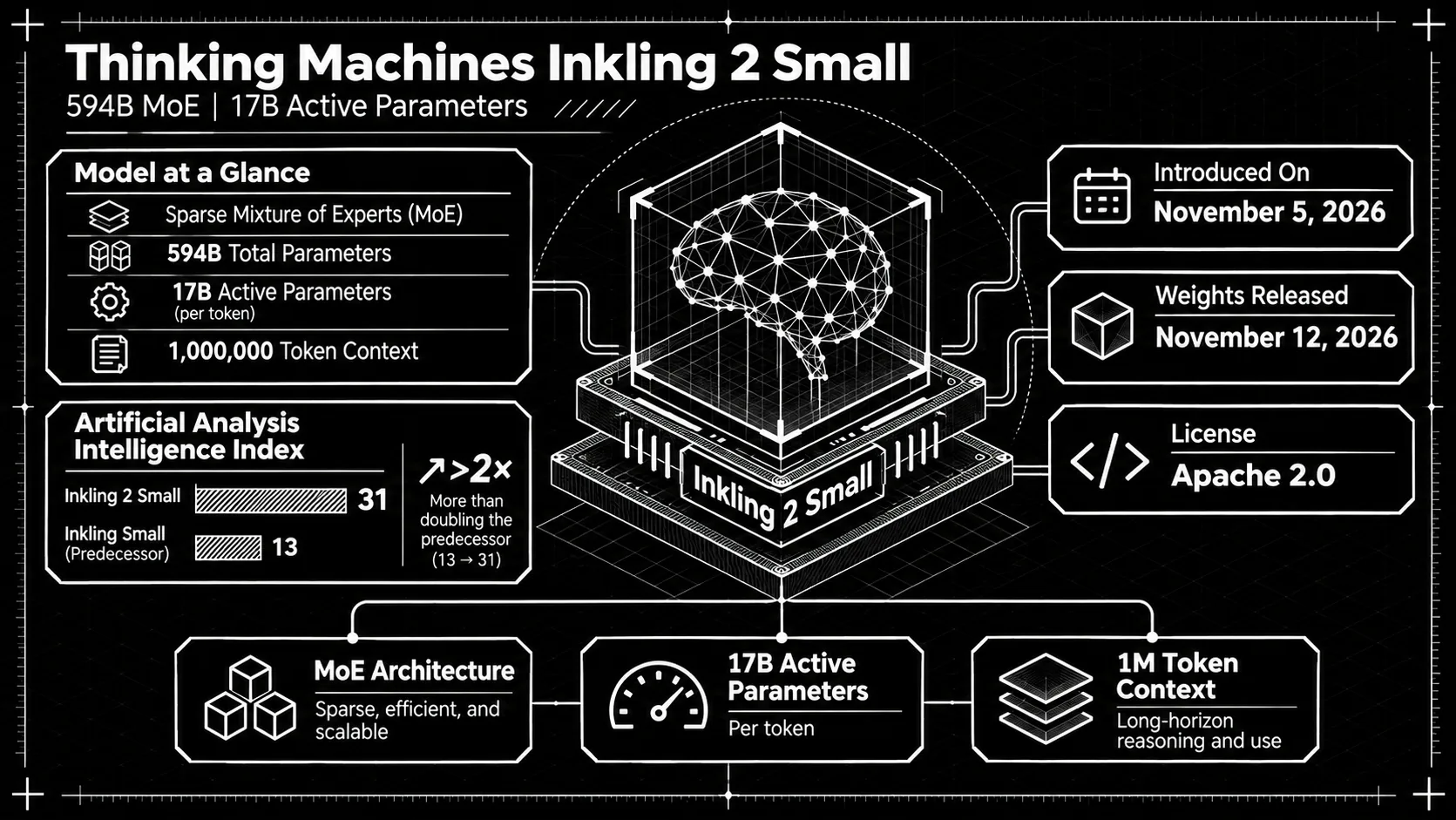
Thinking Machines Lab introduced Inkling 2 Small on November 5 2026. It is the first model of the company's second generation. A sparse Mixture of Experts with 594 billion total parameters and 17 billion active parameters per token. Supports image inputs and variable reasoning effort. Scores 31 on the Artificial Analysis Intelligence Index, more than doubling the predecessor Inkling Small at 13.
The model launched with closed weights on the Tinker platform. Thinking Machines Lab said it would publish full weights under Apache 2.0 the following week after external safety testing and red teaming. The weights were actually published on Hugging Face under Apache 2.0 on November 12.
| Aspect | Inkling 2 Small | Inkling Small Predecessor | Inkling Larger Sibling |
|---|---|---|---|
| Release date | Nov 5 2026 | Jul 15 2026 | Jul 15 2026 |
| Total parameters | 594 billion | 276 billion | 975 billion |
| Active parameters | 17 billion | 12 billion | 41 billion |
| Architecture | MoE 48 layers 384 experts top 8 | MoE | MoE 66 layers 256 experts top 6 |
| Context window | 1 million tokens | 256 thousand tokens | 1 million tokens |
| Image inputs | Yes | Yes | Yes plus audio |
| Audio inputs | No | Yes | Yes |
| AA Intelligence Index | 31 | 13 | not disclosed |
| Weights license | Closed then Apache 2.0 | Apache 2.0 | Apache 2.0 |
| Input price per million | 0.30 dollars | 0.58 dollars | 1.87 dollars |
| Output price per million | 1.00 dollars | 1.44 dollars | 4.68 dollars |
| Cached input per million | 0.03 dollars | 0.116 dollars | 0.374 dollars |
| Weights download size | 394 GB | not disclosed | 2 terabytes plus |
2. What Inkling 2 Small Actually Is And Is Not
A multimodal autoregressive transformer from Thinking Machines Lab. 48 layer decoder only transformer with sparse MoE feed forward backbone. Each token routed to 8 of 384 experts. Attention hybrid of local and global layers. Natively multimodal with images encoded via a vision transformer. Image and text inputs projected into shared hidden space and processed jointly by decoder.
Text and image inputs, text outputs. Context window up to 1 million tokens. Numerics support MXFP8 and NVFP4. Weights available on Hugging Face under Apache 2.0. Also available via Tinker fine tuning platform and third party inference providers including Together AI Cloudflare OpenRouter Fireworks Baseten Nebius Modal and NVIDIA.
NVFP4 checkpoint needs GPU cluster with at least 500 gigabytes of aggregated VRAM. Example configurations: 2x NVIDIA B300 GPUs or 4x NVIDIA H200 GPUs. MXFP8 checkpoint needs at least 800 gigabytes aggregated VRAM. Example configurations: 4x NVIDIA B300 GPUs or 8x NVIDIA H200 GPUs. NVFP4 is native precision and recommended. MXFP8 has marginal 1 to 2 percentage points gain over NVFP4 but not meaningful for practical use.
Not a chat optimized model. Less optimized for chat experience. Issues include worse organization and presentation of content overuse of slashes and overreaction to mental health and safety related queries. Not audio capable. Does not support audio inputs. Not the most succinct communicator. Does not always choose the best tools especially in codebases with large number of skills.
3. Training Process and Architecture Evolution
Initial pretraining phase H1 covered 8.4 trillion tokens of natural language code and image data. Ran for 68 hours on NVIDIA GB300 NVL72 racks enabling high expert parallelism. Training ran natively in NVFP4 the 4 bit floating point format introduced with NVIDIA Blackwell GPU architecture. Later training mixes were mostly trajectories sampled from earlier models including Kimi K3 and Thinking Machines Lab's own models.
Thinking Machines Lab trained with reinforcement learning on hundreds of thousands of long horizon coding tasks across multiple agent harnesses. Reports that the model follows instructions more closely considers changes carefully and verifies its own work without being asked. Large unified RL run contributed to capability gains across agentic coding vision knowledge work and reasoning.
| Feature | Inkling First Gen | Inkling 2 Small |
|---|---|---|
| Layers | 66 | 48 |
| Sliding window layers | 55 | 40 |
| Full attention layers | 11 | 8 |
| Residual path | residual stream | block attention residuals 8 blocks of 6 layers |
| Attention heads query KV | 64 / 8 full 64 / 16 sliding | 48 / 8 in all layers |
| Sliding window size | 512 | 1024 |
| Attention output | plain | sigmoid gate and per token sink |
| Short convolutions | 4 per layer kernel size 4 | same |
| MoE experts | 256 routed top 6 plus 2 shared sinks first 2 layers dense | 384 routed top 8 no shared experts all layers MoE |
| Expert precision | NVFP4 | NVFP4 layers 0 to 39 MXFP8 layers 40 to 47 |
| Image encoder | 4 layer hMLP on 40x40 patches | 23 layer ViT 1024 wide on 20x20 patches |
| Modality | text image audio in text out | text image in text out |
| Speculative decoding | 8 chained MTP heads | DSpark draft 7 tokens per step |
4. Benchmarks and Real World Results
| Benchmark | Inkling 2 Small | Comparison |
|---|---|---|
| MMMU Pro Standard 10 | 81.6 percent | not disclosed |
| Chartography | 80.4 percent | rank 10 of 20 |
| Screen Spot Pro | 83.8 percent | rank 2 of 3 |
| Baby Vision | 93.7 percent | rank 7 of 17 |
| Math Vision | 92.8 percent | rank 5 of 10 |
| Design Arena | 1340 Elo | not disclosed |
| MCP Atlas computer use | 85.4 percent | rank 7 of 50 |
| Automation Bench AA | 45.6 percent | rank 15 of 17 |
| Benchmark | Inkling 2 Small | Comparison |
|---|---|---|
| AA Briefcase v1.1 | 1527 Elo | predecessor 912 Elo |
| Vals Index v2.2 | 56.1 percent | rank 17 of 30 |
| Tax Agent Bench | 65.8 percent | rank 10 of 71 |
| Legal Research Bench | 46.6 percent | rank 17 of 88 |
| tau cubed Banking | 40.4 percent | rank 20 of 120 |
Artificial Analysis measured about 1 dollar 18 cents per index task at 150K output tokens per task. Nearly 6 times the predecessor Inkling Small at 0 dollars 20 cents. About 15.7 minutes per task versus 7.0 minutes for predecessor. The model is notably verbose and slow per task. The unit price of 0 dollars 30 cents input is only slightly above the class median but output volume drives the bill.
| Benchmark | Inkling 2 Small | Comparison |
|---|---|---|
| SWE Bench Pro v2 Hard | 86.3 percent | Second only to Kimi K3 in the table |
| SWE Bench Verified | 82.2 percent | rank 7 of 108 |
| DeepSWE v1.1 | 72.1 percent | DeepSeek V4.1 Flash 77.0 percent |
| SWE Bench Multilingual | 81.2 percent | rank 10 of 48 |
| Vibe Code Bench v1.1 | 81.6 percent | DeepSeek V4.1 Flash 87.7 percent |
| Frontier Code v2.0 | 25.4 percent | DeepSeek 28.5 percent predecessor 5 percent |
| SWE Marathon | 38.8 percent | rank 12 of 15 |
5. Pricing and Availability
MoE models priced by active parameters rather than total model size. Serverless inference in beta for Inkling 2 Small Inkling and Inkling Small only.
Hugging Face under Apache 2.0. NVFP4 checkpoint 394 GB. MXFP8 checkpoint larger. Main NVFP4 checkpoint recommended for all use cases.
| Model Context | Prefill input per million | Cached prefill per million | Sample output per million | Train per million |
|---|---|---|---|---|
| Inkling 2 Small 64K | 0.30 dollars | 0.03 dollars | 1.00 dollars | 1.50 dollars |
| Inkling 2 Small 256K | 0.30 dollars | 0.03 dollars | 1.00 dollars | 3.00 dollars |
| Provider | Input per million | Output per million | Cached input per million |
|---|---|---|---|
| Together AI | 0.30 dollars | 1.00 dollars | not disclosed |
| Cloudflare Workers AI | 0.30 dollars | 1.00 dollars | not disclosed |
| OpenRouter | 0.30 dollars | 1.00 dollars | not disclosed |
6. Limitations And Gotchas
Key technical specifications and benchmarks below.
| Limitation | Impact | Workaround |
|---|---|---|
| Not chat optimized | Worse content organization overuse of slashes | Use for agentic coding not conversational UI |
| Tool selection | Does not always pick best tools in large skill codebases | Curate available tools per task |
| Verbosity | About 150K output tokens per task 4x predecessor | Set max output tokens lower |
| Speed | 15.7 minutes per task on AA index vs 7.0 predecessor | Accept longer runtime for complex tasks |
| No audio | Image and text only | Use Inkling first gen for audio workloads |
| Safety overreaction | Overreacts to mental health and safety queries | Add input filtering for sensitive topics |
| Hardware | 500GB VRAM minimum for NVFP4 800GB for MXFP8 | Use API providers instead of self hosting |
| Weights timeline | Closed at launch Apache 2.0 one week later | Weights now available on Hugging Face |
Need this built for your business?
We engineer custom ai engineering and production AI architectures tailored to your existing tech stack.
Frequently Asked Questions
Who is behind Thinking Machines Lab
Founded in February 2025 by Mira Murati former OpenAI CTO. Co founders include John Schulman OpenAI cofounder and chief scientist Barret Zoph former OpenAI VP of research post training Lilian Weng former OpenAI VP. About 30 researchers and engineers roughly two thirds from OpenAI. Company closed a 5 billion dollar funding round at 40 billion dollar valuation in November 2026.
Is Inkling 2 Small open weights
Yes as of November 12. Weights published on Hugging Face under Apache 2.0. Initially launched November 5 with closed weights on Tinker only. Apache 2.0 release came after external safety testing and red teaming.
Can I run Inkling 2 Small locally
Technically yes but requires serious hardware. NVFP4 checkpoint needs at least 500 gigabytes aggregated VRAM example 2x B300 or 4x H200. MXFP8 needs at least 800 gigabytes example 4x B300 or 8x H200. Weights download is 394 GB. More practical to use API providers.
How does Inkling 2 Small compare to Inkling first gen
Inkling first gen is 975B total 41B active supports text image audio in text out. Inkling 2 Small is 594B total 17B active supports text image in text out no audio. AA Intelligence Index 31 vs predecessor 13. Architecture evolved from 66 layers to 48 layers with 384 experts instead of 256 plus shared sinks. Image encoder upgraded from 4 layer hMLP to 23 layer ViT.
What is variable reasoning effort
The model supports configurable thinking effort. Official benchmark table measured at xhigh effort 0.99 and temperature 1.0 with 1 million token trajectory cap. Default effort scores will be lower.
Why is Terminal Bench 4.0 so low at 13.1 percent
Terminal Bench 4.0 tests terminal agent work which is different from code patch work measured by SWE Bench. The model scores 86.3 percent on SWE Bench Pro v2 Hard but only 13.1 percent on Terminal Bench 4.0. Do not judge the model on any single number.
Is the model good for long context
Long Bench v2 score 70.6 percent rank 1 of 27 models. Context window up to 1 million tokens. Strong long context retrieval and reasoning.
What companies use or integrate Inkling 2 Small
Available via Tinker fine tuning platform and third party inference providers Together AI Cloudflare OpenRouter Fireworks Baseten Nebius Modal NVIDIA. Snowflake Cortex Training offers public preview for fine tuning. vLLM has day 0 support. Article prepared by Astra Principal AI Systems Engineer Slacode Engineering Journal Data sourced from Thinking Machines Lab official announcement November 5 2026 model card blog post Tinker pricing page vLLM blog Snowflake Cortex Training announcement and independent summaries by Plotly ModelBrief Inferama Edge AI and others. All performance figures vendor reported or from third party evaluations not independently reproduced unless noted.
Astra is a content writer at Slacode, creating clear, informative, and engaging content on technology, software development, digital solutions, and business growth. With a focus on accuracy, readability, and practical insights.